Krishna
In the vast expanse of Vedic literature, Lord Krishna is celebrated as the embodiment of divine sweetness and the ultimate source of all rasas, or transcendental mellows. The term “rasa” refers to the profound spiritual emotions and relationships that devotees experience with the Supreme Personality of Godhead. Śrīla Rūpa Gosvāmī, in his seminal work Bhakti-rasāmṛta-sindhu, elucidates that there are five primary rasas: neutrality (śānta), servitorship (dāsya), friendship (sakhya), parental affection (vātsalya), and conjugal love (madhura). Each of these represents a unique and intimate way in which a devotee can connect with Krishna, the akhila-rasāmṛta-mūrti, or the personification of all transcendental mellows.
The Concept of Rasa in Devotional Service
The Vedic scriptures proclaim, “raso vai saḥ,” indicating that the Supreme Lord is the reservoir of all pleasure. This foundational understanding underscores that every living entity inherently seeks pleasure, and the highest pleasure is found in the loving service of Krishna. The Nectar of Devotion introduces Krishna as the cause of all causes and the reservoir of all rasas, encompassing relationships such as neutrality, servitorship, friendship, parental affection, and conjugal love, along with secondary rasas like comedy, compassion, and wonder.
Krishna’s Manifestation of the Five Primary Rasas
-
Neutrality (Śānta-rasa): In this mellow, devotees appreciate Krishna’s greatness and opulence without active engagement in His service. The sages who meditate on the impersonal Brahman aspect of the Lord eventually realize that the impersonal effulgence is but a partial representation of Krishna’s full personality. Recognizing this, they develop a passive adoration for His supreme qualities.
-
Servitorship (Dāsya-rasa): This rasa is exemplified by devotees like Hanumān, who serve the Lord with unwavering devotion and consider themselves humble servants. In the context of Krishna’s pastimes, figures such as Raktaka and Patraka serve Him personally, attending to His needs with deep affection and reverence.
-
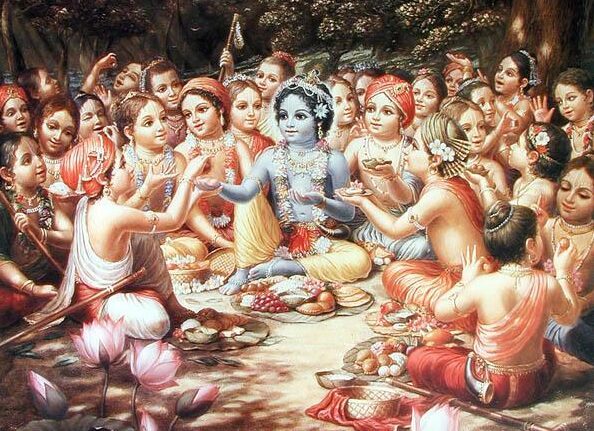
Friendship (Sakhya-rasa): The cowherd boys of Vṛndāvana, including Śrīdāmā and Sudāmā, share a bond of friendship with Krishna marked by equality and playful camaraderie. They engage in various pastimes, such as tending cows and playing games, treating Krishna as one of their own, oblivious to His supreme position.
-
Parental Affection (Vātsalya-rasa): Nanda Mahārāja and Mother Yaśodā epitomize this mellow, wherein they nurture Krishna with parental love, caring for Him as their beloved child. Mother Yaśodā’s affectionate chastisement and concern for Krishna’s well-being highlight the depth of this relationship.
-
Conjugal Love (Madhura-rasa): The pinnacle of devotional relationships is exhibited by the gopīs, with Śrīmatī Rādhārāṇī at the forefront. Their selfless, intimate love for Krishna transcends material understanding and represents the highest form of spiritual union. The Rāsa-līlā dance is a profound manifestation of this rasa, where Krishna reciprocates the gopīs’ unparalleled devotion.
Krishna as the Source of All Pleasure
The Taittirīya Upaniṣad states, “raso vai saḥ,” emphasizing that Krishna is the ultimate source of all rasas and, consequently, all pleasure. When devotees engage in their respective relationships with Him, they experience transcendental bliss that surpasses any material happiness. This realization leads to the understanding that true satisfaction is found in the loving service of the Supreme Lord.
The Unique Position of Madhura-rasa
Among the primary rasas, madhura-rasa is considered the most exalted, as it encompasses and enhances the qualities of the other mellows. Śrī Caitanya Mahāprabhu, who is Krishna Himself in the mood of Śrīmatī Rādhārāṇī, descended to relish and propagate this supreme rasa. His teachings and personal example illuminate the path for devotees to aspire towards this intimate relationship with the Lord.
Conclusion
Understanding Krishna as the reservoir of all rasas enriches the devotee’s spiritual journey, offering diverse avenues to cultivate a personal relationship with the Divine. By engaging in devotional service and immersing oneself in the narratives of Krishna’s pastimes, one can experience the profound sweetness and boundless joy inherent in these transcendental mellows. As the Bhagavad-gītā asserts, upon realizing the Supreme Personality of Godhead, one attains true, lasting happiness, rooted in the eternal, loving exchanges with Krishna.