A Deep Look into Mercy Beyond Rules
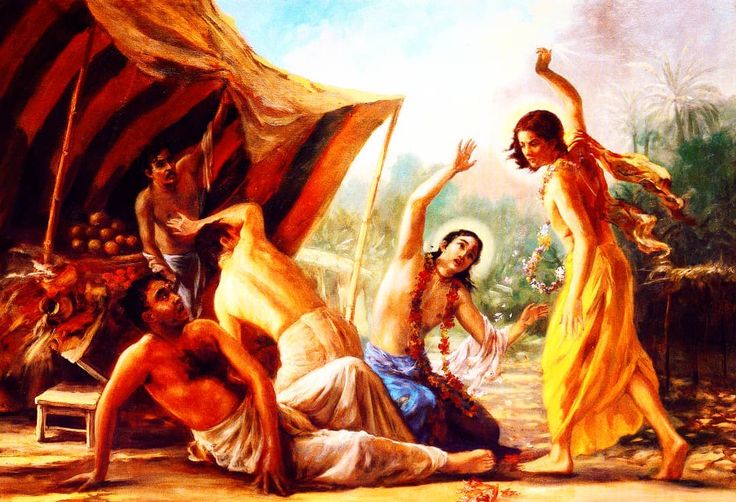
Among all the pastimes of the Lord and His associates, the deliverance of Jagāi and Mādhāi by Nityānanda Prabhu stands as one of the most powerful demonstrations of mercy in Kali-yuga. Yet, a thoughtful theological question often arises:
Did Nityānanda Prabhu break the ninth offense to the holy name by approaching such sinful, faithless persons?
To answer this, we must understand what the ninth offense actually is, what Nityānanda Prabhu did, and the difference between glorifying the holy name and inviting someone to chant.
Understanding the Ninth Offense
The ninth offense to the holy name is described as:
“To instruct the glories of the holy name to the faithless.”
This offense exists because the holy name is supremely pure. If its glories are explained to someone who is hostile, mocking, or disrespectful, it may result in further blasphemy—an even greater offense.
Importantly, the offense is not about giving the holy name, but about elaborately glorifying it to those who will misuse or ridicule it.
This distinction is crucial.
What Did Nityānanda Prabhu Actually Do?
When Nityānanda Prabhu approached Jagāi and Mādhāi, they were:
-
Drunkards
-
Violent
-
Blasphemous
-
Completely fallen by social and moral standards
Yet, what was His approach?
He did not:
-
Give philosophical discourses
-
Explain the confidential glories of nāma-tattva
-
Demand faith or qualification
Instead, He simply said:
“Chant the holy name of Kṛṣṇa! Take the name of Hari!”
This was an invitation, not an instruction of glories.
Inviting to Chant vs. Instructing the Glories
This is the heart of the conclusion.
🔹 Instructing the glories
-
Requires receptivity
-
Requires some faith
-
Can lead to offense if the hearer is hostile
🔹 Inviting someone to chant
-
Is universally auspicious
-
Requires no qualification
-
Is itself purifying
-
Is an act of compassion, not offense
The holy name does not wait for purity—it creates purity.
Why Nityānanda Prabhu Committed No Offense
Nityānanda Prabhu is not an ordinary preacher. He is the embodiment of mercy, acting directly under the will of Śrī Caitanya Mahāprabhu.
More importantly:
-
He did not violate the spirit of the ninth offense
-
He did not expose the holy name to ridicule
-
He gave the name itself as medicine
Even when Mādhāi struck Him, Nityānanda Prabhu did not withdraw mercy. Instead, He pleaded for their deliverance.
This shows that mercy sometimes operates beyond rules, without ever contradicting their essence.
Mercy Is Higher Than Formality
Śrīla Prabhupāda repeatedly emphasized that the holy name is:
-
Self-manifest
-
Self-purifying
-
Supremely independent
The offense is meant to protect the holy name, not restrict mercy.
Nityānanda Prabhu’s act teaches us:
-
Rules exist to preserve reverence
-
Mercy exists to rescue the fallen
-
And the highest preaching is giving the holy name with compassion
Final Conclusion
Did Nityānanda Prabhu break the ninth offense?
No.
He did not instruct the glories of the holy name to the faithless.
He invited the fallen to chant—and by chanting, they became faithful.
Jagāi and Mādhāi stand today not as offenders, but as eternal proofs that:
No one is disqualified from mercy.
A Lesson for Us
We may not imitate Nityānanda Prabhu, but we can follow His mood:
-
Be compassionate
-
Be careful
-
Give the holy name humbly
-
Trust its power to transform hearts
Jai Nityānanda!
Jai Gaura!
Haribol!