Introduction
Many people pray to Krishna when they are in pain.
Few remember Him after relief arrives.
In Krishna consciousness, gratitude is not politeness—
it is spiritual awareness.
Gratitude is the soul’s natural response when it recognizes one truth:
“Nothing I have is truly mine. Everything is Krishna’s mercy.”
What Is Gratitude in Bhakti?
Gratitude (kṛtajñatā) means:
-
Remembering Krishna as the source of all good
-
Acknowledging mercy even in difficulty
-
Serving with thankfulness, not entitlement
A grateful devotee does not ask,
“Why did this happen to me?”
He asks,
“What is Krishna teaching me through this?”
Krishna Teaches Gratitude Through Relationship
Krishna does not measure offerings by quantity—
He responds to consciousness.
-
He ate the fruit offered with love
-
He accepted Sudāmā’s chipped rice as a treasure
-
He protected devotees who simply remembered Him with gratitude
Krishna is conquered not by wealth or words,
but by a thankful heart.
The Opposite of Gratitude: Entitlement
When gratitude disappears, entitlement enters.
Entitlement says:
-
“I deserve this.”
-
“Krishna should do this for me.”
-
“Why is my life difficult despite devotion?”
Gratitude dissolves ego silently.
It keeps devotion soft, sweet, and alive.
🌸 Gratitude in Tears – Three Living Pastimes
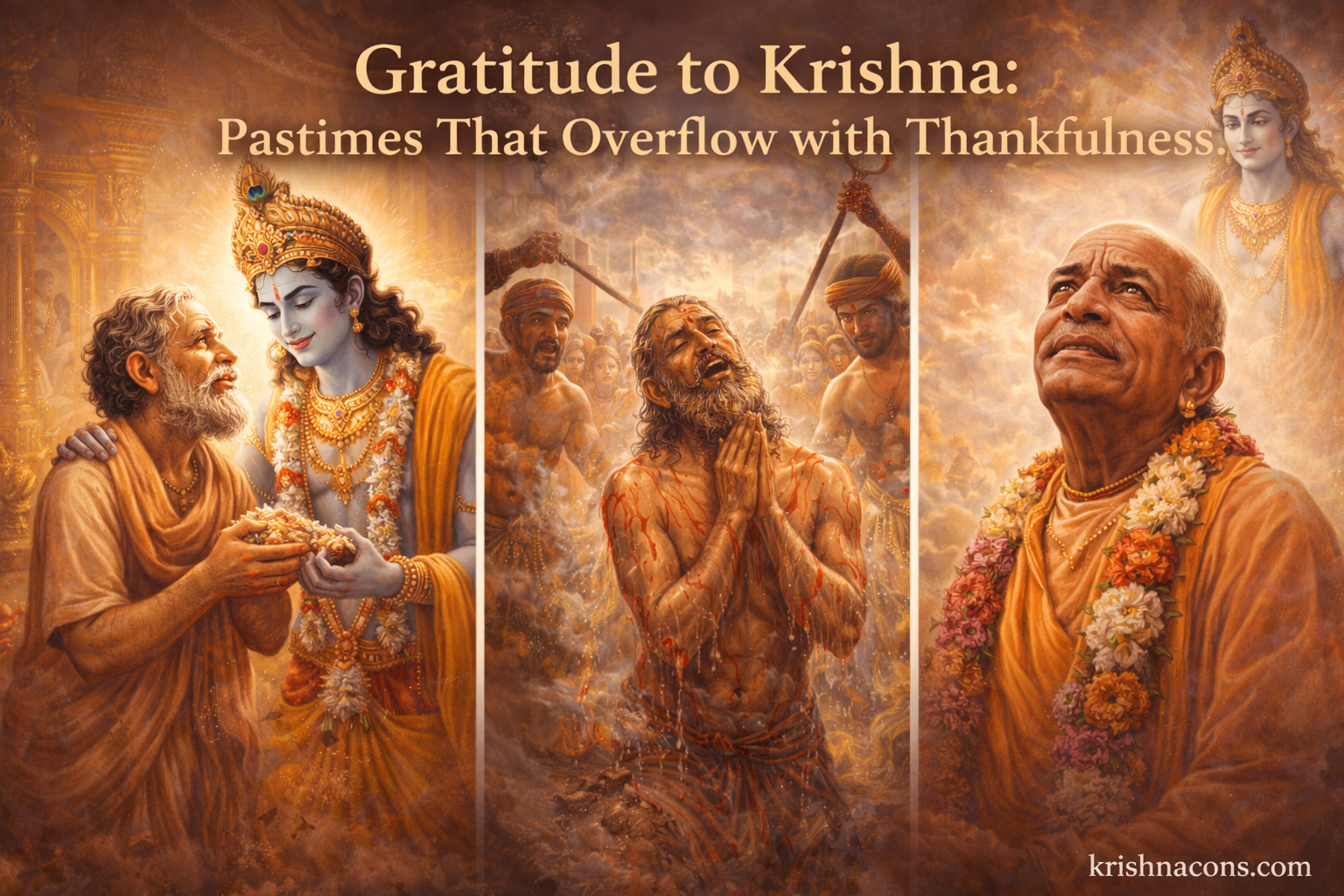
1️⃣ Śrīmad Bhāgavatam – Sudāmā Brāhmaṇa: Gratitude That Would Not Ask
(SB pastime)
Sudāmā walked toward Dvārakā with trembling steps.
In his hand was a small bundle of chipped rice, wrapped shyly in cloth—food so poor that even he felt embarrassed to offer it to the Supreme Lord. With every step, memories flooded his heart: Krishna, his childhood friend… now the Lord of countless universes.
Sudāmā did not come to beg.
He came because his wife said, “Go see your friend.”
When Krishna saw Sudāmā from a distance, He ran barefoot, embraced him tightly, and seated him on His own throne. The Lord of Lakṣmī washed Sudāmā’s feet with His own hands.
Sudāmā wept.
Not because he was poor.
But because Krishna remembered him.
All through the meeting, Sudāmā hid the rice, ashamed. Krishna snatched it, ate it joyfully, and smiled—as if He had received the greatest treasure in creation.
Sudāmā never asked for anything.
His heart was already full.
When he returned home, his hut had become a palace—not because he asked, but because gratitude itself invited mercy.
Emotion of Gratitude:
Sudāmā’s heart said, “I have nothing—but You are everything.”
And Krishna replied, “Then take everything.”
2️⃣ Chaitanya Charitāmṛta – Haridāsa Ṭhākura: Gratitude Even While Bleeding
(Chaitanya Charitāmṛta pastime)
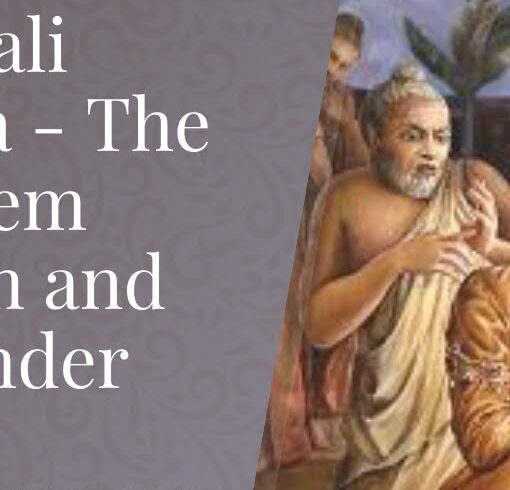
They dragged him from marketplace to marketplace.
Whips struck his back. Blood flowed. Bones shook.
Yet Haridāsa Ṭhākura continued chanting:
Hare Krishna… Hare Krishna…
The executioners were exhausted.
Haridāsa was not.
Inside his heart was no anger.
No complaint.
No demand for justice.
Instead, he prayed:
“My Lord, please forgive them. They do not know the glory of Your holy name.”
Imagine that moment.
A devotee broken in body,
yet overflowing with gratitude that Krishna allowed him to suffer for the holy name.
When Haridāsa survived, people were stunned.
But Haridāsa was not proud.
He simply felt thankful:
“The Lord protected me so I may continue chanting.”
Emotion of Gratitude:
Haridāsa did not thank Krishna after the suffering ended.
He thanked Krishna while suffering, because remembrance never left him.
3️⃣ Śrīla Prabhupāda – Gratitude That Built a Movement
(A. C. Bhaktivedanta Swami Prabhupāda)
He was seventy years old.
Two heart attacks at sea.
No money.
No followers.
No certainty of survival.
Alone in a foreign land, Śrīla Prabhupāda wrote in his diary, praying helplessly to Krishna.
Years later—after temples, books, disciples, and a global movement—his body was failing again. Pain. Fatigue. Relentless work.
Yet his words never changed.
Again and again, he said:
“Krishna has been very kind.”
Not:
-
“I have done so much”
-
“I deserve rest”
-
“People should understand me”
Only gratitude.
Even when misunderstood.
Even when criticized.
Even when his body could barely move.
Emotion of Gratitude:
Śrīla Prabhupāda lived with the feeling:
“If Krishna has used me, my life is perfect.”
That gratitude became his fuel, not exhaustion.
Why Gratitude Is Transformational
Gratitude changes:
-
Complaints into clarity
-
Anxiety into trust
-
Loss into learning
A grateful devotee:
-
Sees mercy where others see misfortune
-
Feels protected even during trials
-
Attracts Krishna’s continued grace
Krishna gives more to one who recognizes what is already given.
Practicing Gratitude Daily (Simple but Powerful)
-
Thank Krishna before asking for anything
-
Remember past rescues and protections
-
Offer food, time, and effort consciously
-
Express gratitude even for lessons that hurt
-
End the day by acknowledging one mercy
Gratitude turns routine devotion into relationship.
Closing Reflection
The world trains us to notice what is missing.
Bhakti trains us to remember what has been mercifully given.
A grateful heart never feels empty—
because Krishna lives there.