When Death Is Not the Enemy, Fear Loses Its Power
Fear governs much of human life — fear of loss, fear of failure, fear of rejection, fear of death itself. Modern solutions teach us how to cope with fear, suppress it, or distract ourselves from it. But the Śrīmad-Bhāgavatam presents something far more radical: fearlessness through surrender.
One of the most astonishing examples of this transcendental fearlessness is found in the life of Vṛtrāsura — a warrior who stood unarmed, open-hearted, and completely fearless before the thunderbolt of Indra.
This was not bravado.
This was not heroism.
This was pure bhakti.
The Thunderbolt That Could Not Create Fear
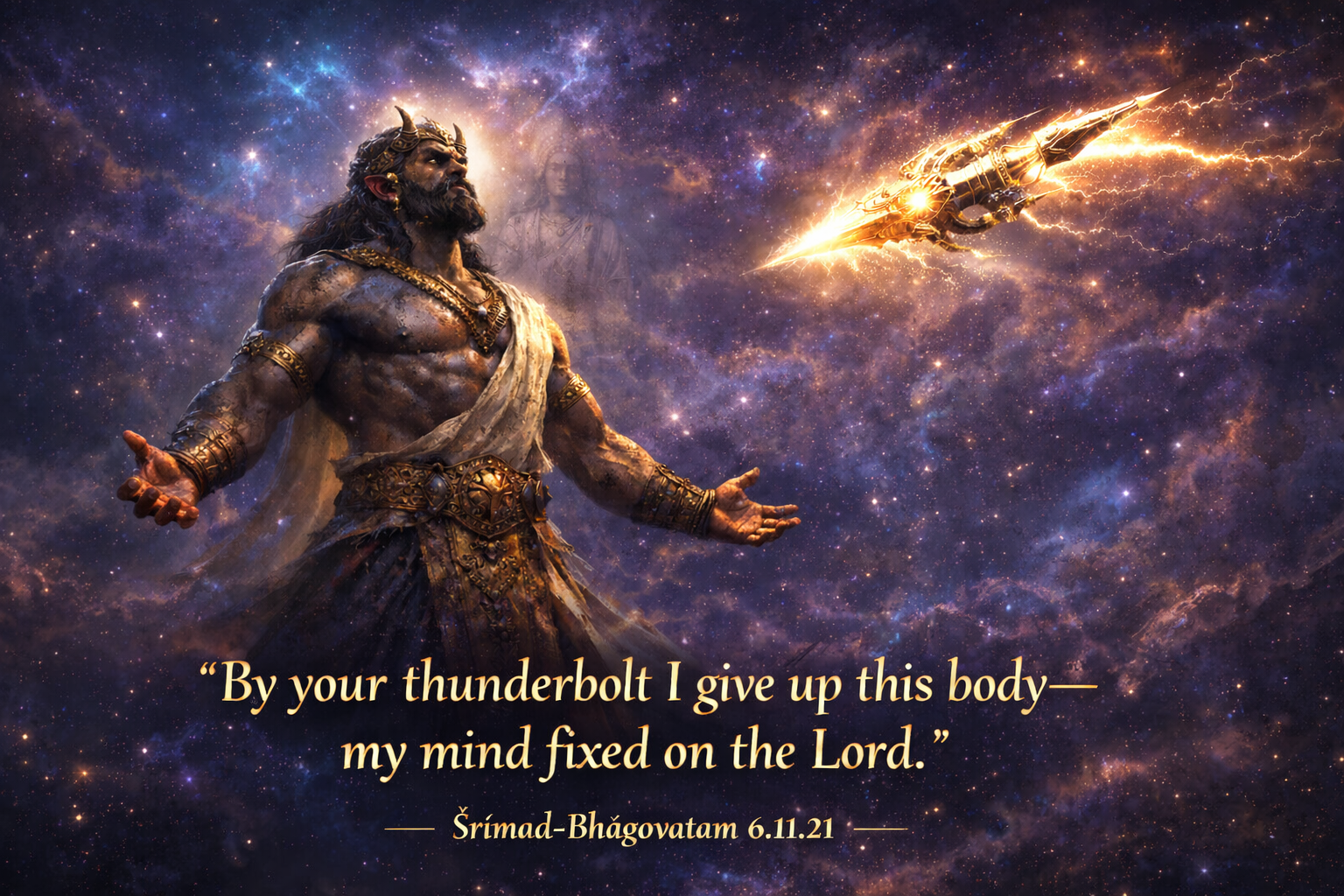
As the battle reached its climax, Indra prepared to strike Vṛtrāsura with the vajra — a weapon empowered by the Supreme Lord Himself. From any material point of view, this was certain death.
Yet Vṛtrāsura spoke words that still echo across time:
“By your thunderbolt I give up this body—
my mind fixed on the Lord.”
Śrīmad-Bhāgavatam 6.11.21
🔗 https://vedabase.io/en/library/sb/6/11/21/
These words are not poetic exaggeration. They are a statement of inner reality.
Why Vṛtrāsura Was Truly Fearless
1. He Did Not Identify With the Body
Vṛtrāsura did not see the thunderbolt as a threat to himself. He understood that the body is temporary and destined to perish anyway. When identification with the body ends, fear automatically collapses.
2. He Saw Death as Liberation, Not Loss
Rather than clinging to survival, Vṛtrāsura saw the thunderbolt as a means of freedom — freedom from material bondage and karmic reactions. For him, death was not darkness; it was release.
3. His Mind Was Already Elsewhere
Fear arises when the mind is fixed on outcomes. Vṛtrāsura’s mind was not on victory, defeat, pain, or survival — it was fixed on the lotus feet of Lord Saṅkarṣaṇa, an expansion of the Supreme Personality of Godhead.
Where the mind is fixed, fear cannot enter.
Fearlessness in Bhakti Is Not Aggression
It is important to understand: Vṛtrāsura’s fearlessness was not violent, angry, or defiant. There was no hatred toward Indra, no bitterness toward destiny, no resistance toward death.
His posture was acceptance.
His strength was surrender.
His courage was stillness.
This is why the Bhāgavatam presents him not as a villain, but as a great devotee.
The Real Lesson for Us
Most of us may never face a thunderbolt — but we face daily versions of it:
-
Sudden loss
-
Uncertainty
-
Illness
-
Criticism
-
Failure
-
Change we did not choose
The question is not whether these thunderbolts will come.
The question is: Where is our mind fixed when they do?
Vṛtrāsura teaches us that:
-
Fear ends where surrender begins
-
Peace is not found by controlling outcomes, but by fixing consciousness
-
When the mind is fixed on the Lord, even the greatest threat loses its terror
A Verse to Live By
Let these words echo daily in the heart:
“By your thunderbolt I give up this body—
my mind fixed on the Lord.”
Śrīmad-Bhāgavatam 6.11.21
This is not a verse about death.
It is a verse about freedom from fear.
Final Reflection
True fearlessness does not come from strength, weapons, position, or control.
It comes from knowing where we belong.
When the mind is fixed on Kṛṣṇa, nothing can truly threaten us.